RSJ News
Nevada student journalist speaks on First Amendment
03-04-2010

Lauren MacLean, 17, and her principal Kevin Lords receive a gift -- a framed rendition of the First Amendment -- from Reynolds School Dean Jerry Ceppos.
By Katie Goodwin
Reynold School student reporter
Lauren MacLean had no idea when she set out to investigate the rumored misconduct of a teacher, that she would be faced with attempted prior restraint of her high school newspaper and consequently, suppression of freedom of the press. She didn’t expect the attention she got from news outlets around the state. She really didn't expect to be speaking about her experience in front of a large crowd of journalism students, faculty and alumni.
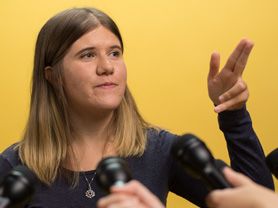
"I'd much rather be on the other side, asking the questions, writing the story," MacLean said March 4, in a talk to journalism students, faculty and friends.
Despite her jokes about the anxiety of public speaking, she presented herself in a cool and collected manner. Greg Ross, a journalism student, attended the speech and described her presence as that of a seasoned public speaker, showing no physical signs of anxiety.
Her story, and the story behind it, fascinates journalists alike. For nearly an hour after her talk, a crowd of faculty and students surrounded her, offering advice, asking questions and congratulating her. After all, her story is perhaps the first of its kind.
It began when this 17-year-old editor-in-chief of Churchill County High School's student newspaper The Flash, received information that students submitted audition tapes for Honor Choir to the school's choir teacher Kathy Archey, yet the tapes never made it to the selection committee. MacLean knew this story was important to her audience. With her news adviser, she devised a plan to fairly report the story. This required the involvement and inevitable approval of the school's principal, Kevin Lords.
"My initial thought was⚊ooh, be careful," said Lords to the audience after MacLean's speech.
Ultimately, Lords approved the article on the basis that MacLean would have the support and advice of an outside party, Steve O'Donoghue, director of California Scholastic Journalism Initiative, and Jerry Ceppos, dean of the Reynold's School of Journalism.
The information MacLean revealed about the missing tapes prompted the Churchill County Educator’s Association to request that the principal stop the publication of The Flash, as the organization believed the information should remain private within the teacher’s association. A representative of the union approached Lords saying that he should support and protect the teachers by pulling the story "Choirgate."
Lords responded that the reason he became an educator was for the students, not for a teacher's association.
"Throughout the process, it was quite easy to make the decisions," said Lords, referring to supporting the school newspaper.
The article was ultimately published on the Lahonton Valley News Web site on January 28 in addition to The Flash the next day.
In the aftermath, MacLean faced harsh criticism from peers, teachers, parents and the leadership of the CCEA. Margie Nuttall, co-chair of teacher’s rights for the CCEA, diminished MacLean’s article to the work of a zealous child, as reported by the Lahontan Valley News. It was extremely difficult to see some of her favorite teachers unsupportive of the story, said MacLean during an interview.
“She handled herself very professionally, better than most adults,” Lords said.
Through it all, MacLean learned quite a bit, from understanding that most people have underlying agendas to the best way to learning how to effectively organize notes. Granted, these valuable life lessons were not what brought the nation's attention to this special story. It was her ceaseless fight to know her rights and use them.
Through this, she was able to apply her rights practically. Although the student staff under MacLean's supervision was not involved in “Choirgate” until the day prior to printing, MacLean was able to translate her knowledge to them.
“They learned what high school journalism can be, not the stereotype of reporting who’s kissing who,” said MacLean. “The First Amendment was resurrected in my life.”